How the Race-Day Programme Grew Beyond a Timetable
See how the race-day programme grew from a simple timetable into a fuller meeting record, and learn what its changing sections can tell you.
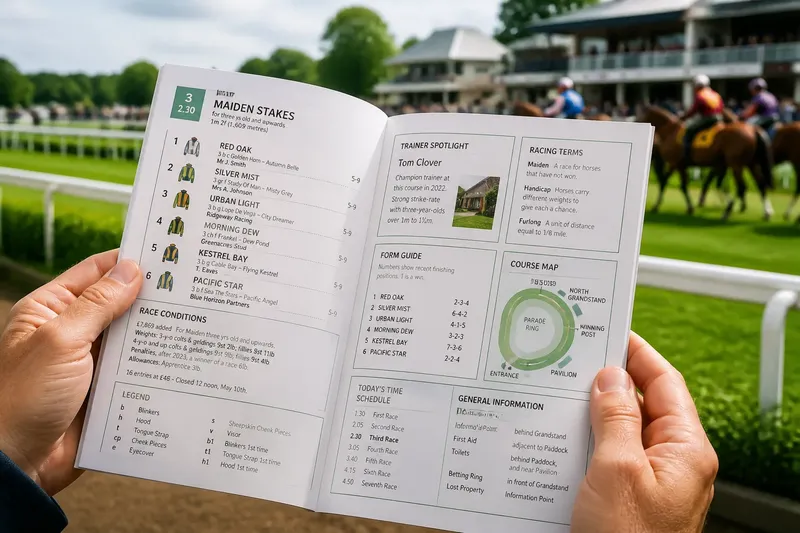
At a racecourse gate, a folded race-day programme might show little more than times and race names. Open it beside the track and its extra layers become visible: participant details, explanations, maps, and notes that help make the meeting legible.
The race-day programme began with a basic task: tell spectators what was happening and when. Its development reflects the questions a timetable alone could not answer, as well as changes in the way race meetings presented information to their audiences.
The race-day programme began as a schedule
A compact printed sheet could set out the order of races and their scheduled times. That was useful at a meeting where spectators needed to know what was coming next, especially if they were unfamiliar with the venue or the day’s format.
The schedule also gave the programme a structure. Race headings separated one event from another, while the listed order helped readers connect what they saw on the track with the printed plan. Even as programmes gained more material, this sequence remained their organizing frame.
Race entries added detail to the timetable
A schedule identifies an event; an entry list helps readers identify its participants. Race entries commonly pair names with numbers and may include conditions or other details. A legend can explain symbols and abbreviations, though the exact layout varies by programme.
This additional information made a programme useful beyond timekeeping. Readers could follow an individual entry on the page, relate its number to a saddlecloth, and distinguish participants with similar or unfamiliar names. The printed page thus became a reference for interpreting the race, not just anticipating it.
Explanatory material answered new questions
As programmes expanded, they could include short profiles, form notes, information about trainers or jockeys, and explanations of racing terms. Such material gave readers context for names and details that a basic listing left unexplained. A map could also show where parts of the venue were located.
These additions served different needs. A glossary helps with terminology; a profile provides background; a course or venue map supports orientation. Their presence turned the programme into a small reference booklet, though readers could still use only the sections relevant to them.
Why did race programmes become more detailed?
What could a timetable tell spectators?
A timetable showed the order and scheduled times of events, helping spectators see what was coming next. By itself, it did not identify participants or explain unfamiliar terms.
How did participant listings change the programme?
Listings connected each race with the people and horses taking part, often using names and numbers. This gave readers a way to follow a particular entry from the page to the action.
Why add maps and explanations?
Maps addressed questions about where things were, while explanations clarified symbols and racing language. These sections helped readers use the programme without needing every detail explained aloud.
Does a printed programme record every change?
No. A printed programme is prepared ahead of the meeting, so time-sensitive changes may be communicated separately. Current venue announcements and displays are the better place to check those updates.
Read the programme as a layered record
Imagine you have a printed programme open to a race entry, and a name on the page is hard to distinguish from another. First, use the race heading to confirm the correct event; next, match the printed number to the saddlecloth; then consult the legend if a symbol remains unclear. The result is a more confident identification without needing to study every profile or note.
It is not worth the effort to memorize every abbreviation or read every entry before the meeting begins. Use the schedule to understand the programme’s structure, then turn to listings, explanations, or maps when a specific question arises.
The race-day programme also preserves how a meeting was presented: which events were listed and what information was offered alongside them. Its growth from a timetable reflects a practical change in purpose, from announcing the day’s sequence to helping spectators interpret its details.