Race-Day Dress Codes: What the Rules Actually Require
A race-day dress code depends on your venue and ticketed area. Learn how to separate actual rules from customs and choose a comfortable, suitable outfit.

You have your race-day ticket in one hand and a jacket in the other, while a photo of hats and tailored suits makes the choice seem obvious. A race-day dress code, though, depends on the particular meeting and the area your ticket admits you to; the familiar image reflects certain settings, not a universal rule.
A race-day dress code depends on the venue and area
Some meetings set clothing requirements for particular enclosures or hospitality spaces. Other events have no general dress code, or ask only for clothing suitable for the venue. Even within one racecourse, the expectations for a public viewing area can differ from those for a members’ enclosure.
Race-day finery is a genuine custom at some events, but a custom is not automatically a rule. Wearing a hat may be a popular choice; a written restriction for a named area is an entry condition. Confusing the two can lead either to needless shopping or to an avoidable problem at the entrance.
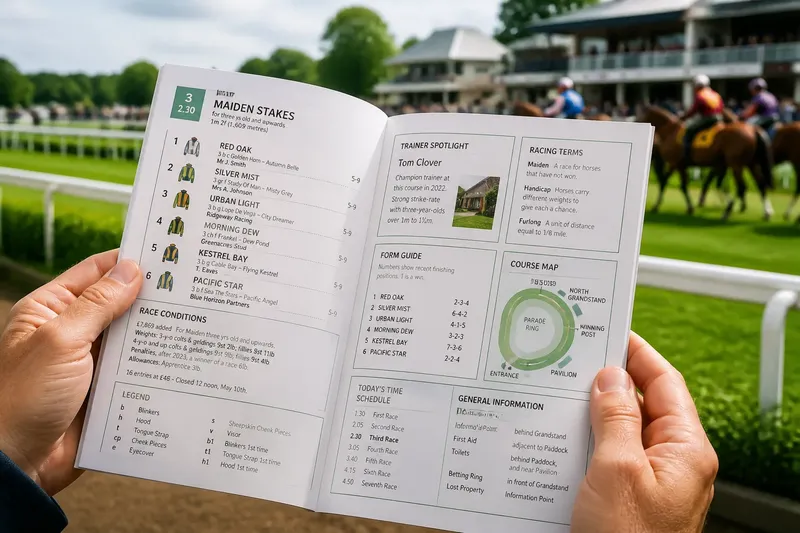
A photograph can show what guests wore at one meeting, in one enclosure, or at one hosted occasion. It cannot establish what every visitor must wear. Treat images as inspiration, and check the instructions that apply to your own booking.
Check the guidance for your ticketed area
Start with the official page for the specific event, then check the racecourse’s visitor information. Search for “dress code,” “admission,” “enclosures,” or “visitor information.” If your ticket names a hospitality lounge or a particular enclosure, look for guidance that mentions that space rather than relying on the venue’s general page alone.
For a hosted event or group booking, read the invitation or organizer’s notes too. “Smart dress” suggests a tidy appearance but does not, by itself, specify a suit, tie, dress, or hat. A direct list of prohibited items or an explicit requirement is more precise.
If the wording leaves an important detail unclear, contact the venue or host before traveling. Ask whether the instruction is mandatory, which area it covers, and whether a particular item is permitted. Current guidance is more useful than an old event photograph or a friend’s recollection.
Read dress-code wording as carefully as the ticket
Words such as “must,” “required,” and “not permitted” indicate a rule. “Recommended,” “encouraged,” or “welcome to dress up” usually signals advice or an invitation, unless the organizer also states a separate condition.
- If the page says an item is required: check that the instruction applies to your ticketed area; if it does, wear an acceptable version, and if it does not, follow the guidance for your own area.
- If a clothing item is listed as not permitted: check whether the restriction covers the whole venue or one enclosure; if it applies to your booking, leave the item behind, and if the scope is unclear, ask the organizer.
- If the page says “smart dress” without examples: check for a separate list of restrictions; if none appears, choose tidy clothing, and if a specific garment matters to your plans, ask what the phrase means there.
- If the event says guests are encouraged to dress up: check whether that wording is an invitation or a stated condition; if it is only an invitation, dress up if you wish, and if a separate rule appears, follow that rule.
- If a photograph shows formal outfits: check whether it identifies your event and enclosure; if it does not, use it only as inspiration, and if you need an answer about entry, consult the venue’s written guidance.
- If the ticket names a hospitality space: check that space’s specific information; if it has separate instructions, follow them, and if none is published, contact the host or venue before choosing an outfit that may be borderline.
These distinctions help separate a social custom from an entry condition, but the organizer’s current wording takes priority. If an ambiguous instruction affects what you plan to wear, get clarification rather than guessing.
Choose clothing that suits the setting
“Smart dress” usually means a neat, considered appearance, not a fixed uniform. Tidy trousers or a skirt with a shirt, blouse, knitwear, or jacket may suit that request, depending on the venue. Read the phrase alongside any examples or restrictions instead of assuming that traditional tailoring is compulsory.
When no detailed code applies, consider where you will spend time, how much you will walk, and what the weather may do. Race-day plans can involve both indoor and outdoor spaces, standing to watch, and walking across paved paths or grass. Comfortable shoes and an adaptable layer may serve you better than formal accessories chosen only for photographs.
Say you have a general-admission ticket for an afternoon meeting, and the event page gives no clothing restrictions. You check the forecast, find that the venue provides no separate dress rule for your area, and choose tidy trousers, a comfortable shirt, a light jacket, and shoes suited to walking. The result is an outfit that fits the event’s relaxed guidance and remains practical as you move between the stands and outdoor viewing areas.
What should you check before choosing an outfit?
Does my ticketed area have a dress code?
Check the exact enclosure or hospitality space named on your ticket, because guidance may differ across the same racecourse. If the venue page is unclear, ask whether its wording is mandatory or advisory.
Are any clothing items specifically prohibited?
Look for an explicit restriction in the event or admission information instead of inferring one from custom. If an item is important to your plans and the wording is unclear, confirm its status with the organizer before setting out.
Will I spend much of the meeting outdoors?
Consider the forecast, the ground, and how much walking or standing your plans involve. Choose footwear and layers for those conditions while staying within any dress rules that apply to your area.
Is dressing up an invitation or a requirement?
Look for direct language that makes clothing a condition of entry; an invitation to dress up is not, by itself, a requirement. You can join the custom if you enjoy it, while keeping any separate venue rules in mind.
Some dress-code clues are not worth the effort
Trying to infer a rule from celebrity photographs, old event coverage, or images that do not identify the enclosure rarely helps. Nor is it useful to buy a complete formal outfit before checking whether the venue asks for one. Those sources can create a strong impression without answering the question your ticket raises.
For a race-day dress code, identify the event and ticketed area, read the current guidance, and choose clothing that suits the setting. The familiar image of race-day finery can remain a custom you enjoy without being mistaken for a universal condition of entry.